
Thinking Doesn't Have to Wait for Knowledge
The knowledge demand of a question is a design choice.

Here is a question.
Which opening move gives White the strongest positional advantage in the Sicilian Najdorf?
Take a moment with it. What happens in your head?
For most people, not much. Unless you play chess, there is nowhere for your thinking to go. You cannot reason about the Najdorf because you do not know what the Najdorf is. The problem is not that you are not clever enough. The problem is that you do not have the knowledge the question demands. So your mind stalls, and you reach for Google.
Now here is a second question.
In a game where two players take turns, do you think moving first is usually an advantage or a disadvantage? Why?
Notice what changed. This time you have something to say. You might be right, you might be wrong, but you can think about it. You weigh it up. You picture taking the first turn. You consider what it gives you and what it gives your opponent. You form a view.
Both questions are about the same thing: the value of position and first-move advantage in a turn-based game. The thinking they ask for is almost identical. Weigh the options. Consider the trade-offs. Predict the outcome. What separates them is not the difficulty of the thinking. It is the amount of knowledge you need before you are allowed in.
Every question you ask a child carries a knowledge demand, an amount they must already know before they can begin to think. And that demand is not fixed by the topic. It is set by you, in the wording, whether you notice you are setting it or not.
What the chess players were really doing
The chess example wasn’t chosen at random. It comes from one of the most famous findings in the study of expertise.
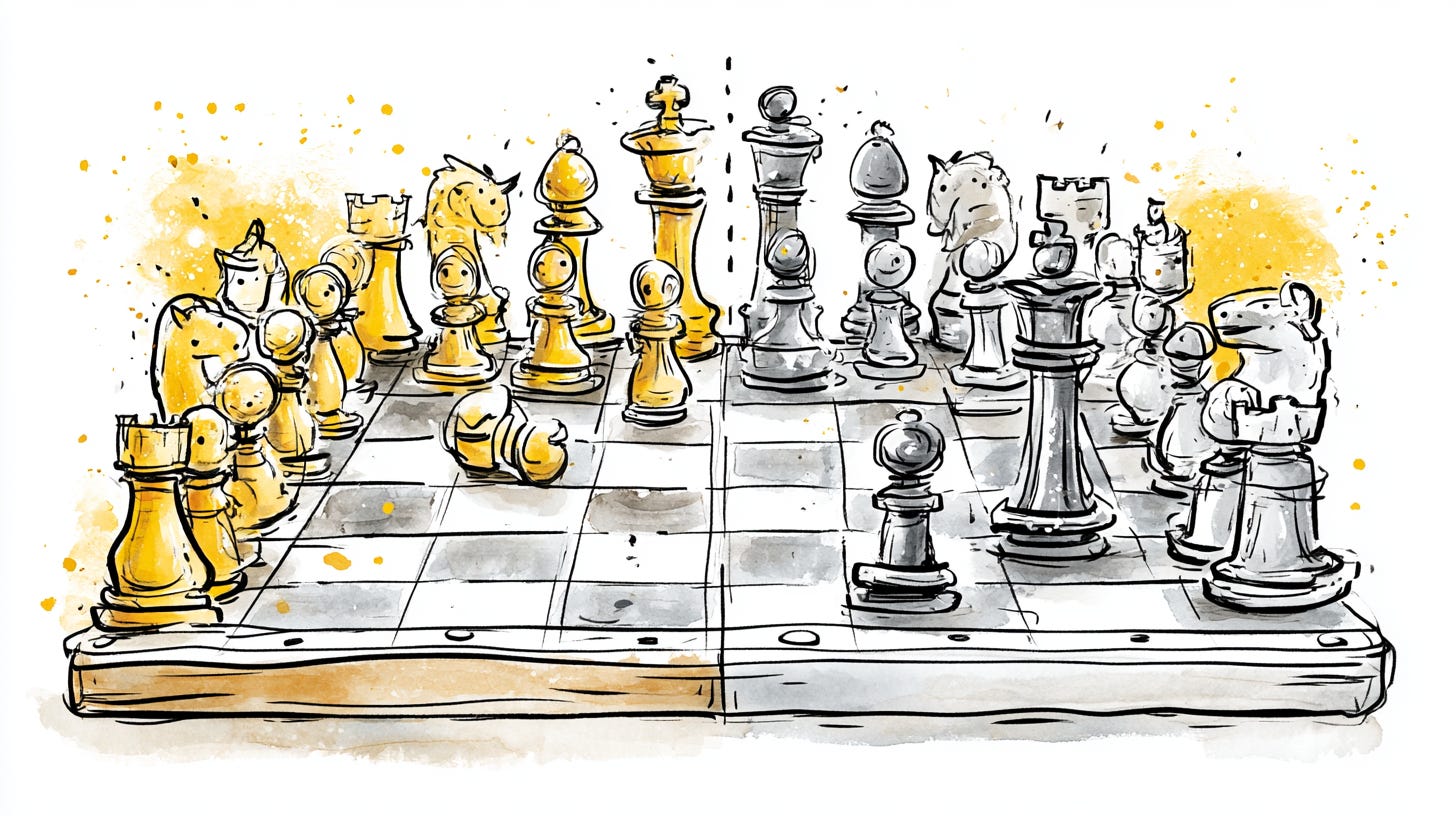
In the 1940s, psychologist Adriaan de Groot set out to understand what separated chess masters from everyone else. He expected the strongest players to think further ahead, calculating more moves and more possibilities than weaker players. That isn’t what he found. Masters and weaker players searched to roughly the same depth. The difference was something else entirely. When shown a real chess position for just a few seconds, masters could reconstruct it almost perfectly from memory. Weaker players could not.
Years later, researchers William Chase and Herbert Simon added an important twist. They showed chess masters two kinds of board. One contained a real game position. The other contained the same pieces scattered randomly. On the real board, the masters’ recall was extraordinary. On the random board, their advantage almost disappeared. Suddenly, they looked much more like everyone else.
The finding matters because it reveals what expertise really is. The masters did not have better memories. They had more knowledge. Years of playing chess had filled their minds with thousands of familiar patterns. When they looked at a real board, they weren’t seeing thirty-two separate pieces. They were seeing meaningful arrangements they had encountered before. Those patterns did the work. Remove the patterns and the advantage disappeared.
So when the Najdorf question stopped you in your tracks, nothing was wrong. You weren’t failing to think. You simply didn’t have enough knowledge to think with.
Knowledge matters. That was never in question.
None of this is an argument against knowledge. Knowledge and thinking are not rivals. They are partners. The more we know about a topic, the more we can do with it. We notice patterns more quickly, make stronger explanations, ask sharper questions, and evaluate ideas more carefully. Knowledge does not replace thinking. It expands what thinking can do.
Daniel Willingham puts it plainly: you cannot think well about something you know little about. Thinking depends on knowledge. The question is not whether knowledge matters. Of course it does. The question is whether knowledge must always come first.
The sequence we rarely question
At first glance, that seems entirely reasonable. After all, how can students think about something they do not know?
But that assumption treats children as though they arrive empty. They don’t.
Long before students encounter our subjects, they have been building theories about the world around them. They have watched things happen, noticed patterns, made predictions, asked questions, and drawn conclusions from thousands of experiences.
The National Research Council’s landmark report How People Learn begins with this idea. Learners come to the classroom with existing beliefs and explanations about how the world works. Those ideas shape everything that follows.
A child may know almost nothing about gravity as a scientific concept. But they have dropped things, thrown balls, climbed trees, and fallen over. They already have ideas about how things move.
A child may know little about fractions as a formal system. But they have shared food, split a chocolate bar, and argued, fiercely, about whether a share was fair.
Their formal knowledge may be limited. Their ability to think is not.

The idea that should change how you plan
If that is true, then thinking cannot be something we save until learning is finished. It must be there from the start.
The knowledge demand of a question is a design choice.
Every time we ask a question, we decide how much knowledge students need before they are allowed to begin thinking.
Most of the time, we treat that demand as fixed. It isn’t. The topic stays the same. The demand changes with the wording.
Take Roman aqueducts.
A high-demand version: “Evaluate the effectiveness of the Roman aqueduct system’s gradient engineering.”
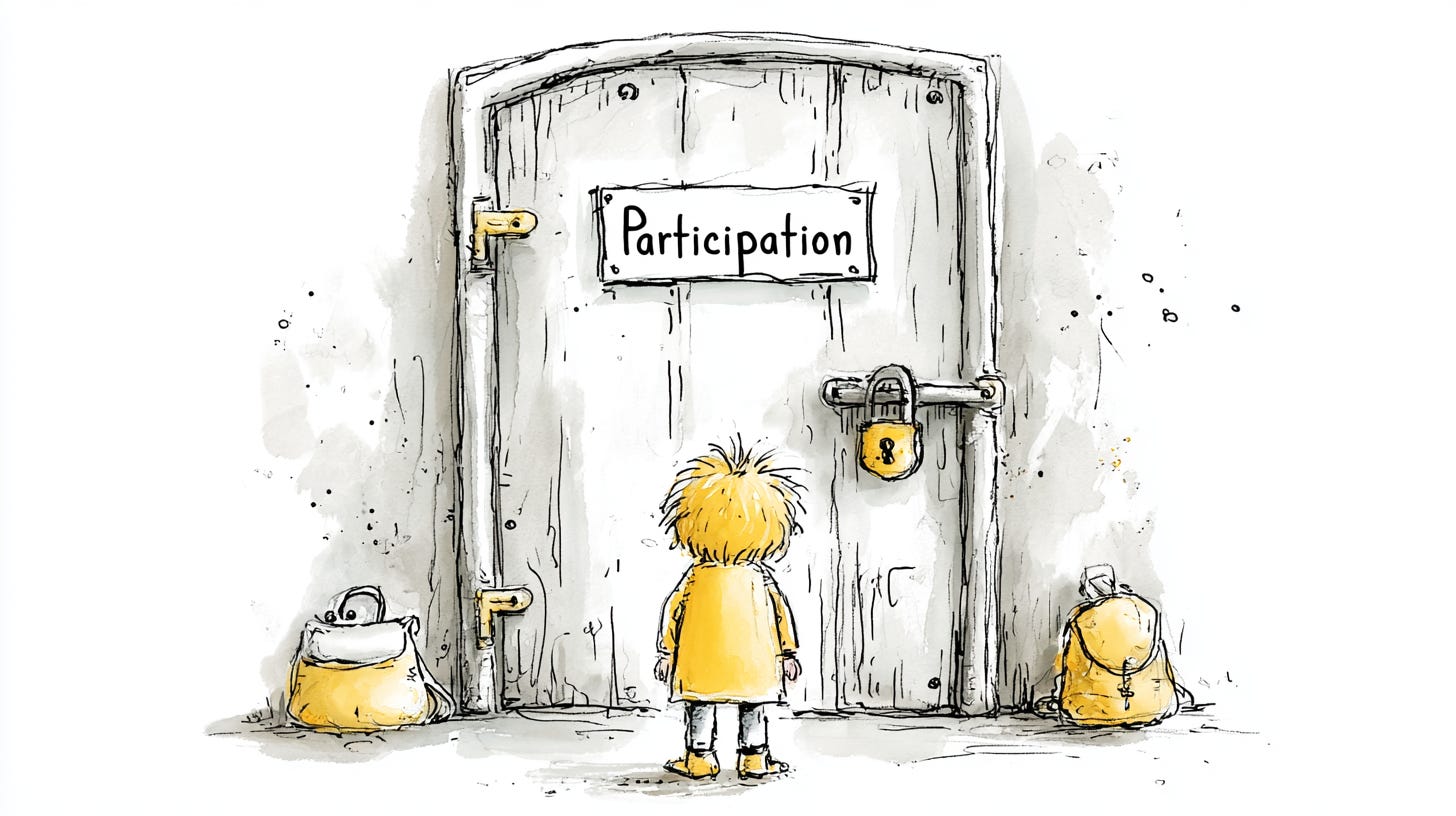
To answer, a child needs vocabulary, mechanisms, and facts they do not yet have. The door is locked until I teach them.
A low-demand version: “If you had to get clean water to a city on a hill, with no pumps and no electricity, how would you do it?”
One version asks, “Evaluate the effectiveness of Roman aqueduct gradient engineering.” To answer, students need vocabulary, mechanisms, and knowledge they probably don’t yet possess. The door is locked.
Every child can think about this. They reason from gravity, from pouring drinks, from watching water run downhill. They predict, they argue, they hit problems. And when I then teach how the Romans actually solved it, the teaching lands on thinking that has already started.
Same content. Same end point. The only thing I changed was the knowledge demand of the opening question. One version made knowledge the locked door children wait outside of. The other made it the thing their thinking reaches for and gradually builds.
One version makes knowledge the thing students must possess before they can think. The other makes knowledge the thing their thinking gradually builds toward.
That is the whole move. Not less knowledge. Not discovery learning. Not abandoning direct instruction. Simply lowering the price of entry to the thinking and then raising it deliberately as the knowledge grows.
What it looks like across a unit
The demand does not stay low. As knowledge grows, the questions grow with it.
Take a unit on erosion.
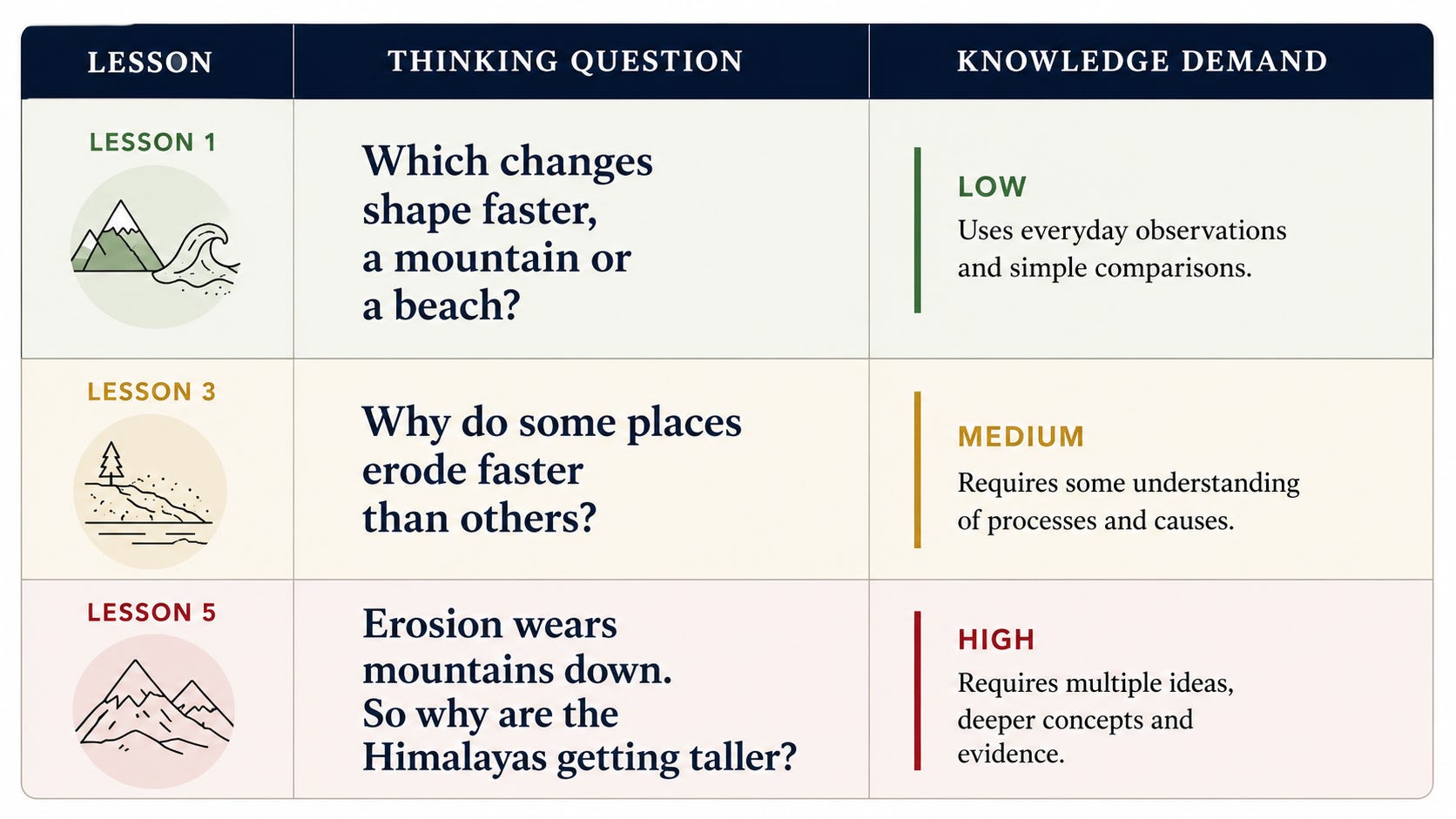
The thinking is present in every lesson. What changes is the knowledge that thinking draws upon. The door never closes. It simply opens wider as students learn more.
Why thinking has to be in from the start
There is a reason this works.
Knowledge grows through explanation, reading, observation, and experience. But it becomes memorable when students use it. When they predict from it, explain with it, solve problems with it, and connect it to other ideas.
Willingham’s most quoted line captures the idea perfectly:
Memory is the residue of thought.
We remember what we think about.
If that is true, then thinking cannot be the reward we hand out once the knowledge is safely installed. Thinking is one of the processes that helps install it. Design a lesson where knowledge is delivered but rarely thought about, and the knowledge that lasts is only the knowledge children happened to think with anyway.
The question was never whether knowledge matters. It does.
The question is how much knowledge we choose to require before students are invited into the thinking.
Because the knowledge demand of a question is a design choice.
And once we see it as a choice, we can design learning differently.
Thinking is not what happens after learning.
It is part of how learning happens.
References
Bransford, J. D., Brown, A. L., & Cocking, R. R. (Eds.). (2000). How People Learn: Brain, Mind, Experience, and School (Expanded ed.). National Academy Press.
Chase, W. G., & Simon, H. A. (1973). Perception in chess. Cognitive Psychology, 4(1), 55–81.
de Groot, A. D. (1978). Thought and Choice in Chess (2nd ed.). Mouton. (Original work published 1946.)
Willingham, D. T. (2009). Why Don’t Students Like School? A Cognitive Scientist Answers Questions About How the Mind Works and What It Means for the Classroom. Jossey-Bass.
Yesss, love this. ❤️
“Children don’t start from zero - they arrive with experiences, ideas, and theories about the world. Our job is to design questions that unlock that thinking.”
You’ve really challenged my thinking around the idea of knowledge demand. The reminder that the knowledge demand of a question is a design choice feels incredibly important. Too often, we assume children can’t think about something because they don’t yet have the formal knowledge, when in reality they may already have experiences, observations, and theories they can draw upon.
What I found most powerful was the idea that thinking shouldn’t be the reward at the end of learning; it should be part of how learning happens. Not less knowledge, but more thoughtful ways of inviting children into the thinking from the very beginning. Thank you for sharing and growing my learning 🙌
oh this is brilliant the knowledge demand of a question!